
What exactly does it mean when a company says it is "Zero Waste" certified?
If we take it at face value, what we understand is that this company does not generate any waste at all, but if we stop to think about it a little more, we realise that this is almost impossible (especially if it is a manufacturing company), and we begin to suspect that there is some "trick", for example, that it does produce them, but that it "compensates" them in some way.
Well: it is neither one thing nor the other, and we will explain it below.
What do we mean by waste
This is the first thing to clarify: what is waste?
According to the RAE, it is the "material that remains unusable after a work or operation has been carried out", and Law 7/2022 ¹ defines it as "any substance or object that its holder discards or intends or is obliged to discard". Putting the two definitions together, we can say that a waste is something that we get rid of, because it is no longer useful to us.
But let's clarify this a bit, because suppose my daughter's bike has outgrown it and I have to throw it away because it is useless to me ... but then I sell it to another family: no one would consider it a waste, would they?
And indeed, the Waste Law¹ also takes this aspect into account, and does not consider as waste something that, being useless to us, we give it to a third party who will use it as it is, that is, without the need to treat it or transform it.
There are other exceptions and special cases that the Law takes into account, but to avoid boring, we can summarise it in a simple rule that rarely fails: if we get paid when we get rid of something, it is not waste, and if we have to pay for it, it is (at least at that moment).
Can a company produce zero waste?
It follows from the previous point that it is practically impossible.
Even in the truly exceptional case that all manufacturing waste could be sold as useful by-products for other industries, there would still be packaging, organic waste etc., which is always produced where there is activity,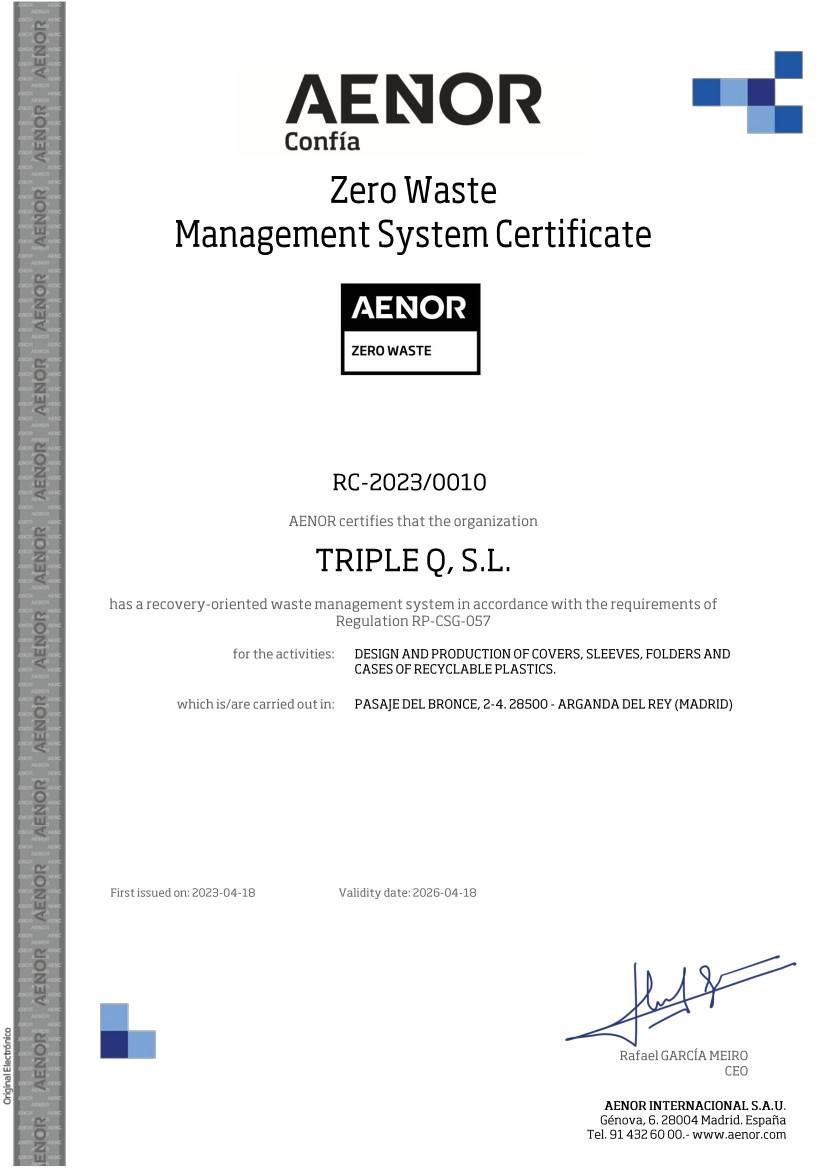
But a responsible company can do something that ultimately results in zero waste:
1-first, it must reduce the waste it generates to the minimum possible
2-and what remains, it can pay specialised waste managers to recover it, either by reuse, recycling or use as fuel. In this way, although they are waste when they leave the company, they are no longer waste, and the company pays the cost of the recovery process.
And when all this is done and done well enough, it is when you can aspire to Zero Waste certification, which is achieved when the auditors check that waste is reduced each year and that the percentage of recovered waste exceeds a certain threshold (not yet required to be one hundred percent, but to be very close and, moreover, to keep getting closer each year)
But the part of external recovery is more difficult than it seems, as we will see in the next point.
How do we know that a waste has been recovered? It's not worth guessing!
One of the trickiest parts is proving that the waste we pay to recover is actually recovered.
A citizen can be satisfied when he puts his waste in the appropriate container: he has done "his part" and assumes that someone (the municipality, Ecoembes, Ecovidrio ....etc) will come along afterwards, who will treat that waste properly.
But this does not apply to a company that wants to achieve Zero Waste. You cannot take anything for granted, but you need evidence of each step that each waste follows to its final destination.
For each of the different wastes² delivered to a manager, you must have full traceability, with documented evidence of each step (including transport) and the administrative authorisations of each of the "actors" to do the treatment they do.
Let's take an example: let's imagine that we deliver a container with paper and cardboard waste to a manager who presents us with his authorisation for the treatment of this LER², we formalise the treatment contract and he sends us a carrier for the collection who also presents us with his corresponding authorisation for this LER... can we rest assured?
Well, no: the first thing to know is whether that manager has the authorisation and means to finish recovering the waste (in other words, to convert the waste into a raw material that can be used in a paper mill). But this is not normally the case: the first manager separates and classifies the waste, then transfers it to another manager who shreds it, and this in turn transfers it to another manager who converts it into pulp, which is then a raw material. Three managers have to intervene until the waste ceases to be waste and is recovered as a raw material. Well, the company that wants to achieve Zero Waste has to know all these managers, know what each one does, and have evidence that they are authorised to do so.
same applies to energy recovery (waste to fuel).
So what exactly does it mean that a company is Zero Waste certified?
It does not mean that the company does not produce any waste.
Nor does it mean that all its waste is recovered.
What it means exactly is the following:
1-that the total volume of its waste is reduced every year.
2-that at least 90% of all its waste is recovered (i.e. less than 10% ends up in landfill).
3-that this percentage of recovered waste is increasing every year, with the aim of reaching 100%.
4-that this recovery is real and fully traceable, i.e. from the time the waste is produced until it is recovered there is evidence of each step and of each manager, and that all of them are duly trained and authorised for the treatment they carry out.
We hope this article has been of interest to you and as always we encourage you to write to us at i+d@tripleq.es with any comments or additional information.
¹ Law 7/2022 of 8 April on waste and contaminated soils for a circular economy.
² Each type of waste is identified with a 6-digit code called LER (European Waste List).
©Triple Q, S.L. 2023-09